Research
The intersection of theory, computation, and observation — understanding galaxy formation, large-scale structure, and the physical processes that shape our Universe.
What do I do?
I am an astrophysicist interested in applying state-of-the-art computational tools to:
- the problems in galaxy formation and evolution and large-scale structure cosmology
- developing hydrodynamical simulations, N-body simulations, and semi-analytical models of galaxy formation to make predictions and create mock catalogues to compare with observations
- analyzing observational data and making robust observational strategies
- constraining theory using observations.
My Research Interests
I'm primarily interested in uncovering "The Synergistic Effects of Physical Processes on Galaxy Evolution", as described below.
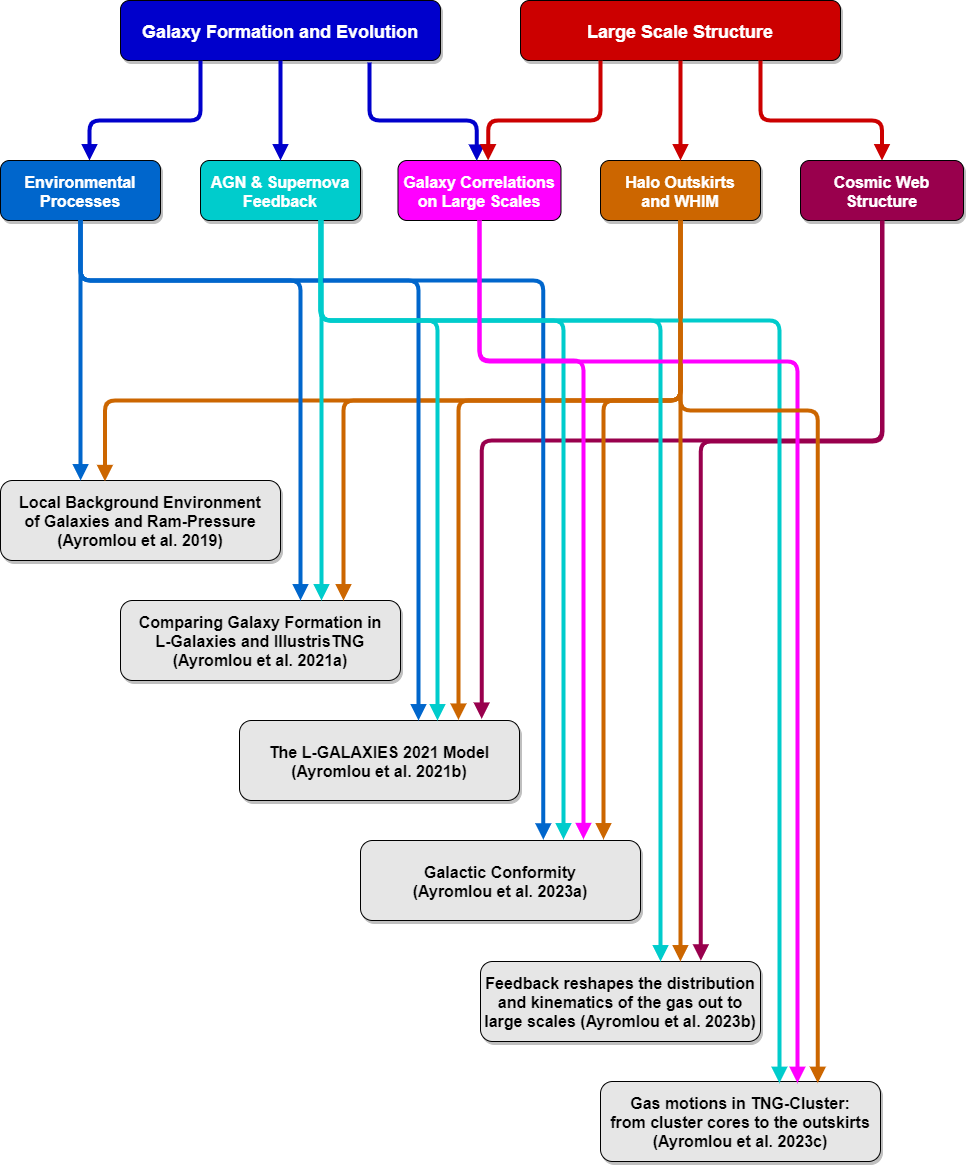
Recent Works
An Atlas of Gas Motions in the TNG-Cluster Simulation: from Cluster Cores to the Outskirts (Ayromlou et al. 2024)
Galaxy clusters are unique laboratories for studying astrophysical processes and their impact on halo gas kinematics. This paper is part of a series presenting first results from the new TNG-Cluster simulation, a suite comprising 352 high-mass galaxy clusters including the full cosmological context. Studying the dynamics and coherence of gas flows, we find that gas motions in galaxy cluster cores and intermediate regions are largely balanced between inflows and outflows. In the outskirts, the net velocity distribution becomes asymmetric, featuring a double peak where the second peak reflects cosmic accretion. Our analysis shows no clear relationship between line-of-sight and radial gas velocities. A velocity structure function (VSF) analysis indicates more coherent gas motion in the outskirts and more disturbed kinematics towards halo centers. The outcome of TNG-Cluster broadly aligns with observations of the VSF of multiphase gas across different scales.
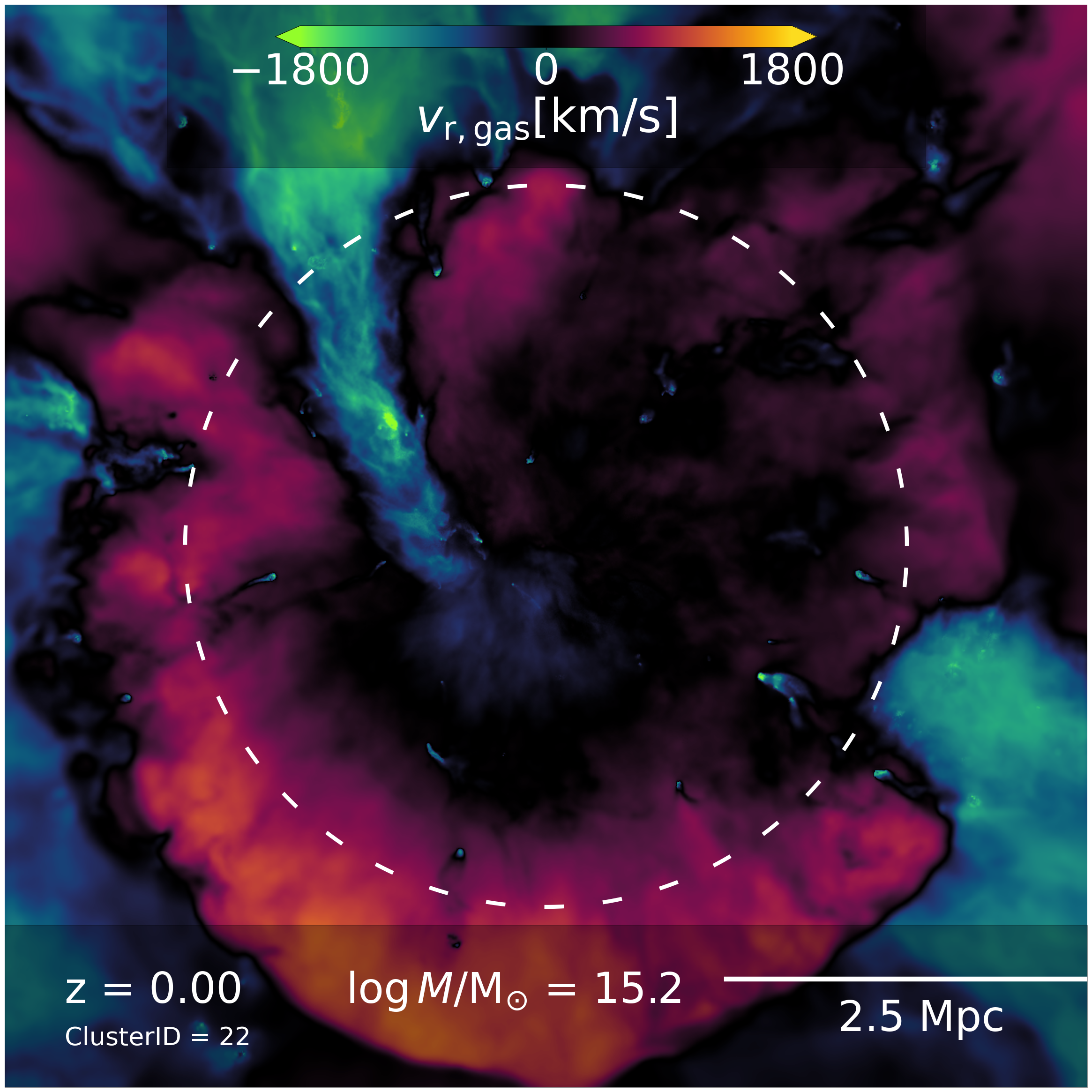
Figure: Gas kinematics (radial velocity) in and around a massive halo of the TNG-Cluster simulation.
The Closure Radius: Feedback reshapes the distribution of baryons (Ayromlou et al. 2023b)
We explore three sets of cosmological hydrodynamical simulations, IllustrisTNG, EAGLE, and SIMBA, to investigate the physical processes impacting the distribution of baryons in and around haloes across an unprecedented mass range. We define the closure radius — the characteristic scale beyond which the baryon fraction reaches the cosmic mean. Feedback processes redistribute baryons well beyond the traditional halo boundary.
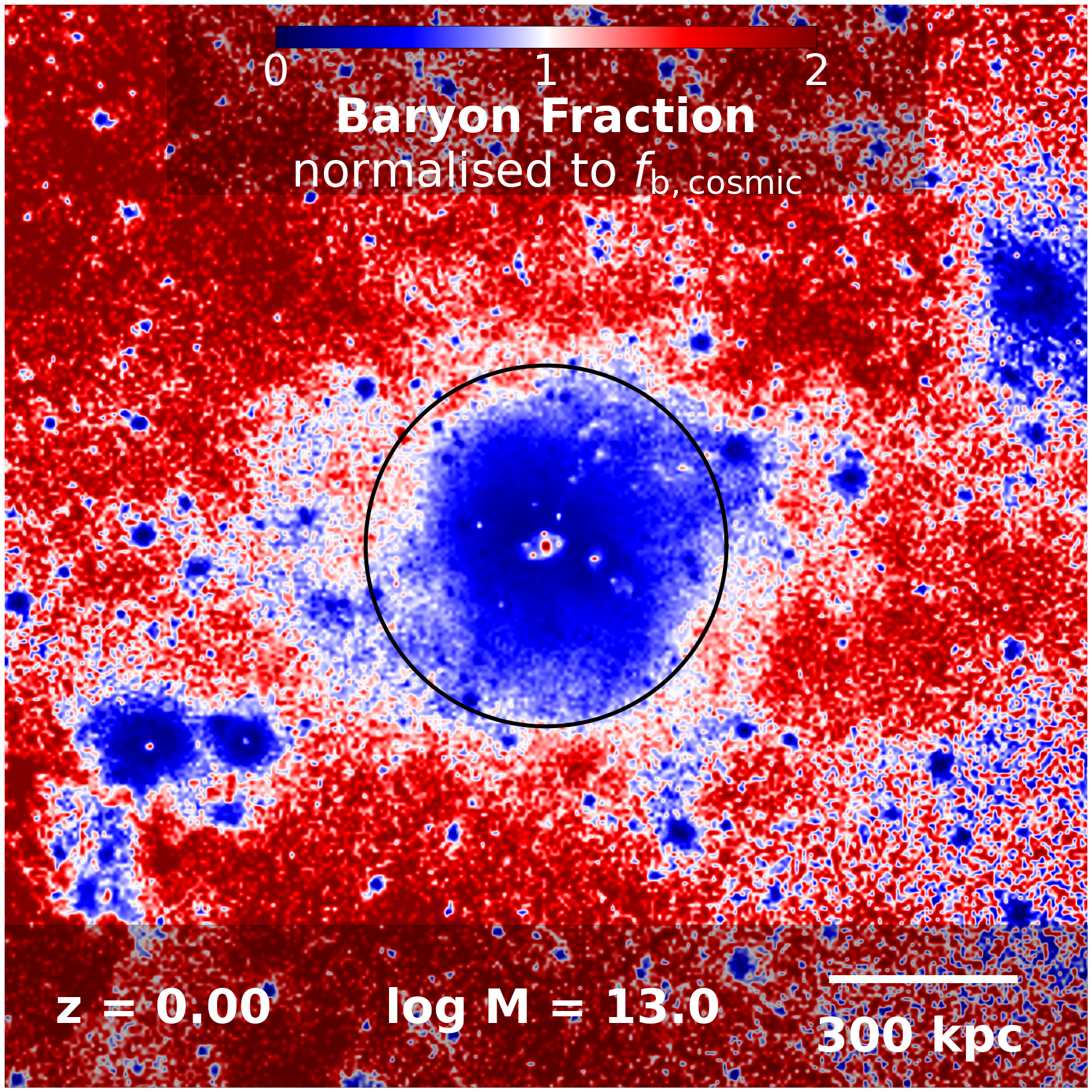
Figure: The baryon fraction in a cosmological simulation. The circle shows the halo virial radius. Missing baryons can be found beyond the halo boundary, within the closure radius.
The physical origin of galactic conformity (Ayromlou et al. 2023a)
We employ several galaxy formation models — L-GALAXIES, IllustrisTNG, and EAGLE — as well as observational samples from SDSS and DESI, to investigate galactic conformity. We introduce CENSAT, a new algorithm to classify central and satellite galaxies. We find that the conformity signal is present up to at least 5 Mpc from the centres of low- and intermediate-mass centrals in the latest version of L-GALAXIES, IllustrisTNG, and EAGLE, as well as in SDSS and DESI. Much, but not all, of the signal arises from primary galaxies near massive systems.
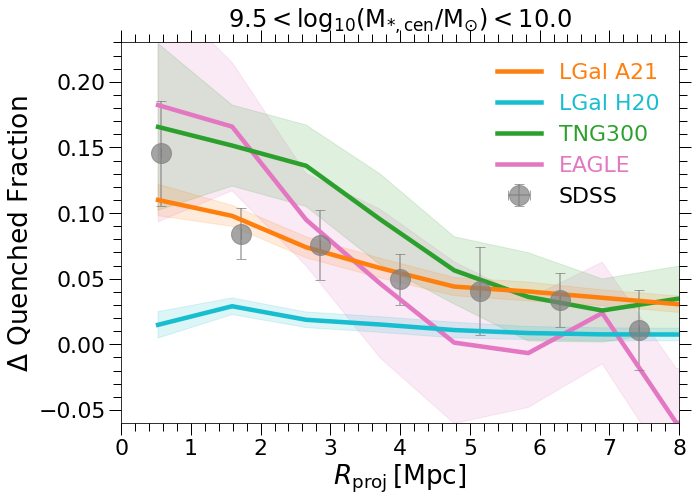
Figure: The galactic conformity signal. The L-Galaxies model (Ayromlou et al. 2021b) is in very good agreement with observations.
Galaxy Formation with L-GALAXIES (Ayromlou et al. 2021b)
We present a variation of the Munich semi-analytical galaxy formation model, L-Galaxies, with a new gas stripping method. We directly measure the local environmental properties of galaxies to formulate a more accurate treatment of ram-pressure stripping for all galaxies. By comparing to data from SDSS and HSC surveys, we demonstrate that our modified model improves the agreement with the quenched fractions and star formation rates of galaxies as a function of environment, stellar mass, and redshift.
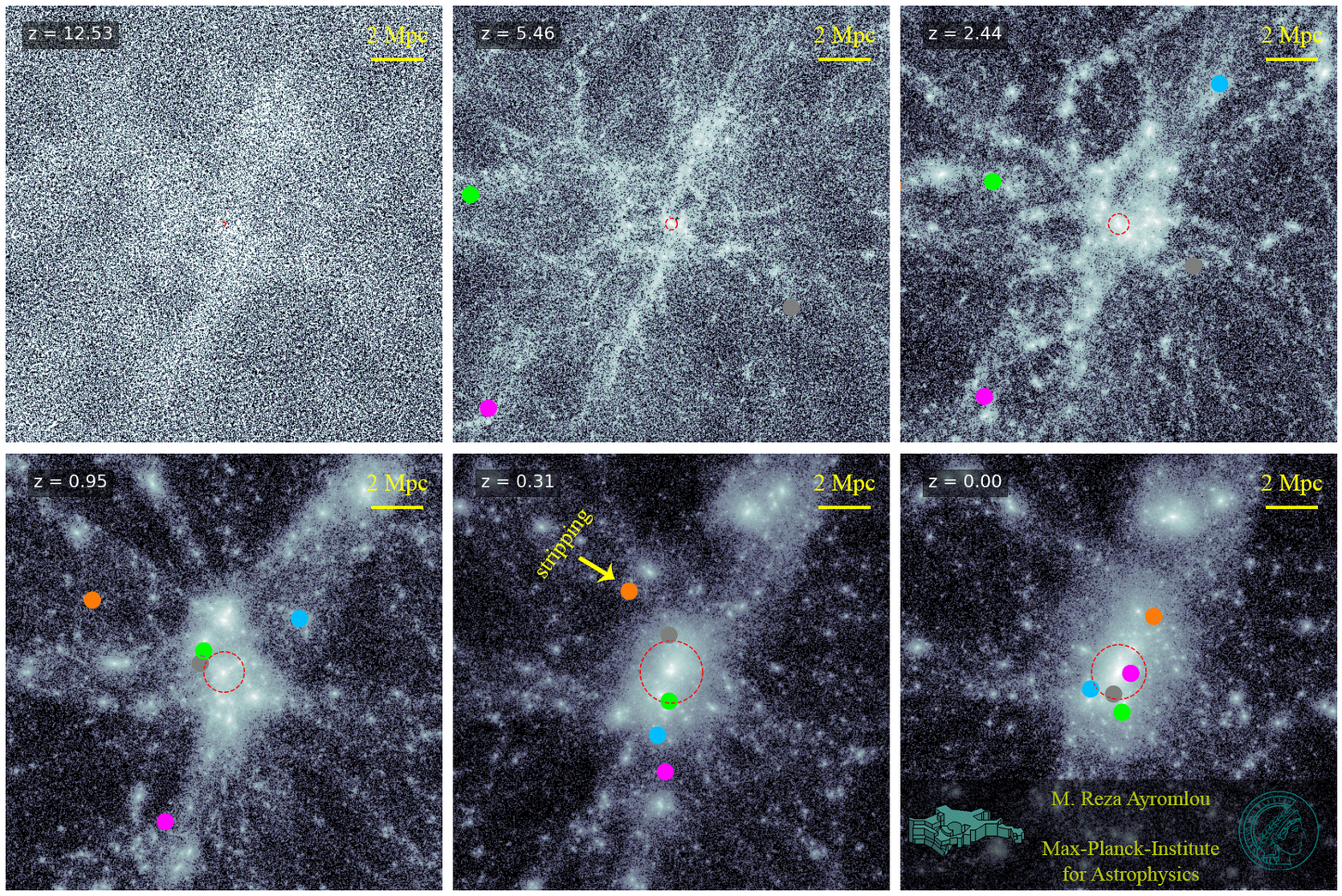
Figure: Evolution of a cluster and five sample galaxies experiencing strong ram-pressure stripping through cosmic time.
Comparing Galaxy Formation Models (Ayromlou et al. 2021a)
We perform a comparison, object-by-object and statistically, between the Munich semi-analytical model, L-Galaxies, and the IllustrisTNG hydrodynamical simulations. By running L-Galaxies on the IllustrisTNG dark matter-only merger trees, we identify the same galaxies in the two models. We find that both the stellar mass functions and the stellar masses of individual galaxies agree to better than ~0.2 dex. At z=0 the transition between low-mass star-forming galaxies and high-mass quenched galaxies occurs at a stellar mass scale ~0.5 dex lower in IllustrisTNG than in L-Galaxies.
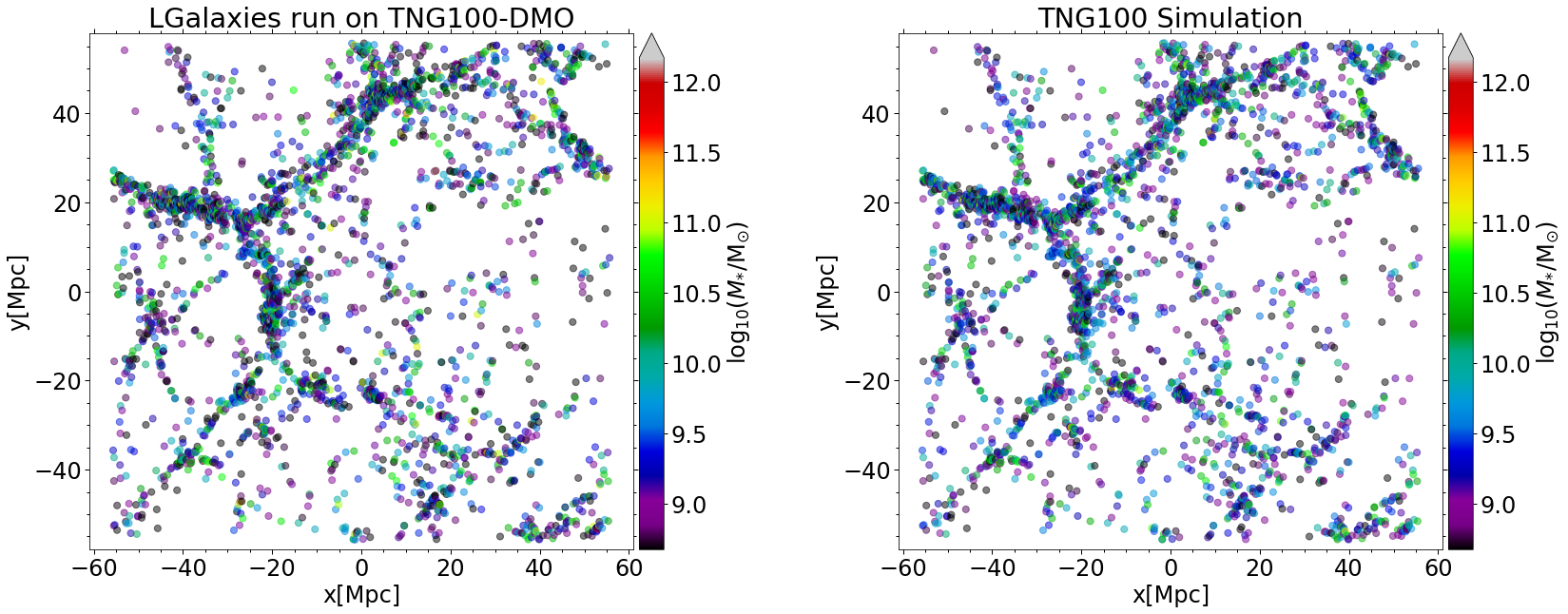
Figure: Visual overview of galaxy stellar mass, comparing L-Galaxies (left) vs. IllustrisTNG (right).
A New Method to Quantify Environment and Model Ram-Pressure Stripping (Ayromlou et al. 2019)
We introduce a local background environment (LBE) estimator that can be measured in and around every galaxy or its dark matter subhalo in high-resolution cosmological simulations. The LBE is designed to capture the influence of environmental effects such as ram-pressure stripping (RPS). We find that the LBE of satellite galaxies is not at rest with respect to their host halo, in contrast to typical assumptions. There is no abrupt change in LBE velocity or density at the halo virial radius, suggesting that stripping should also happen beyond this radius.
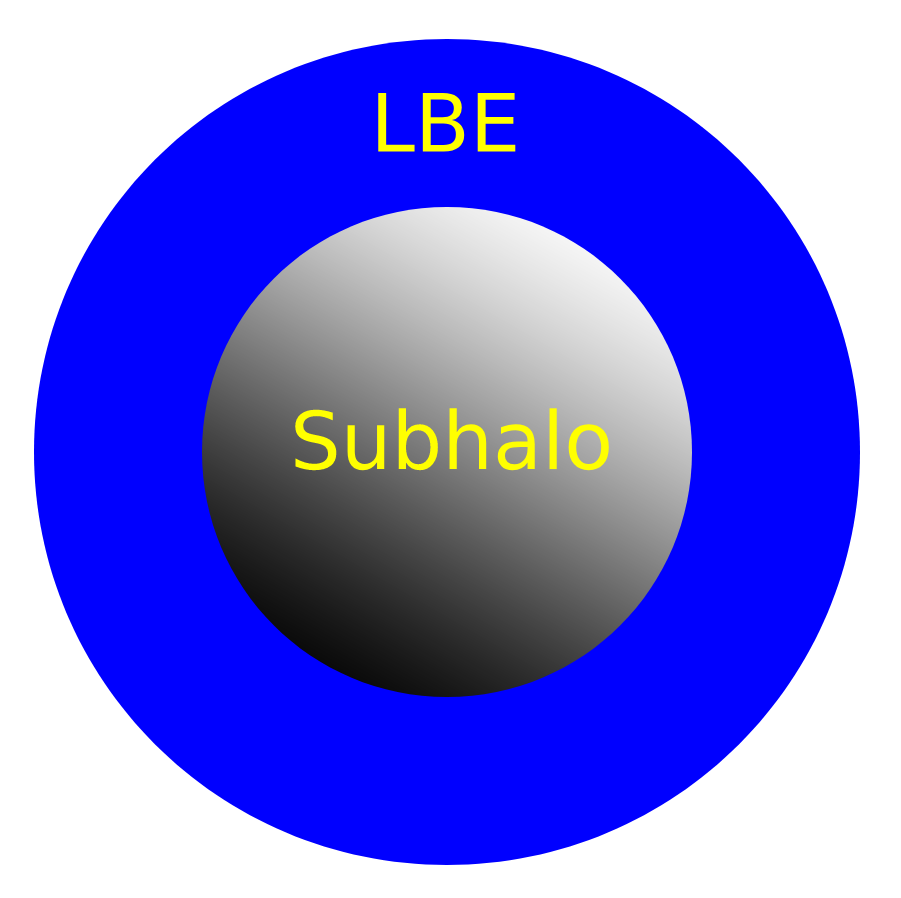
Figure: Schematic visualization of the local background environment surrounding a galaxy and its subhalo.